
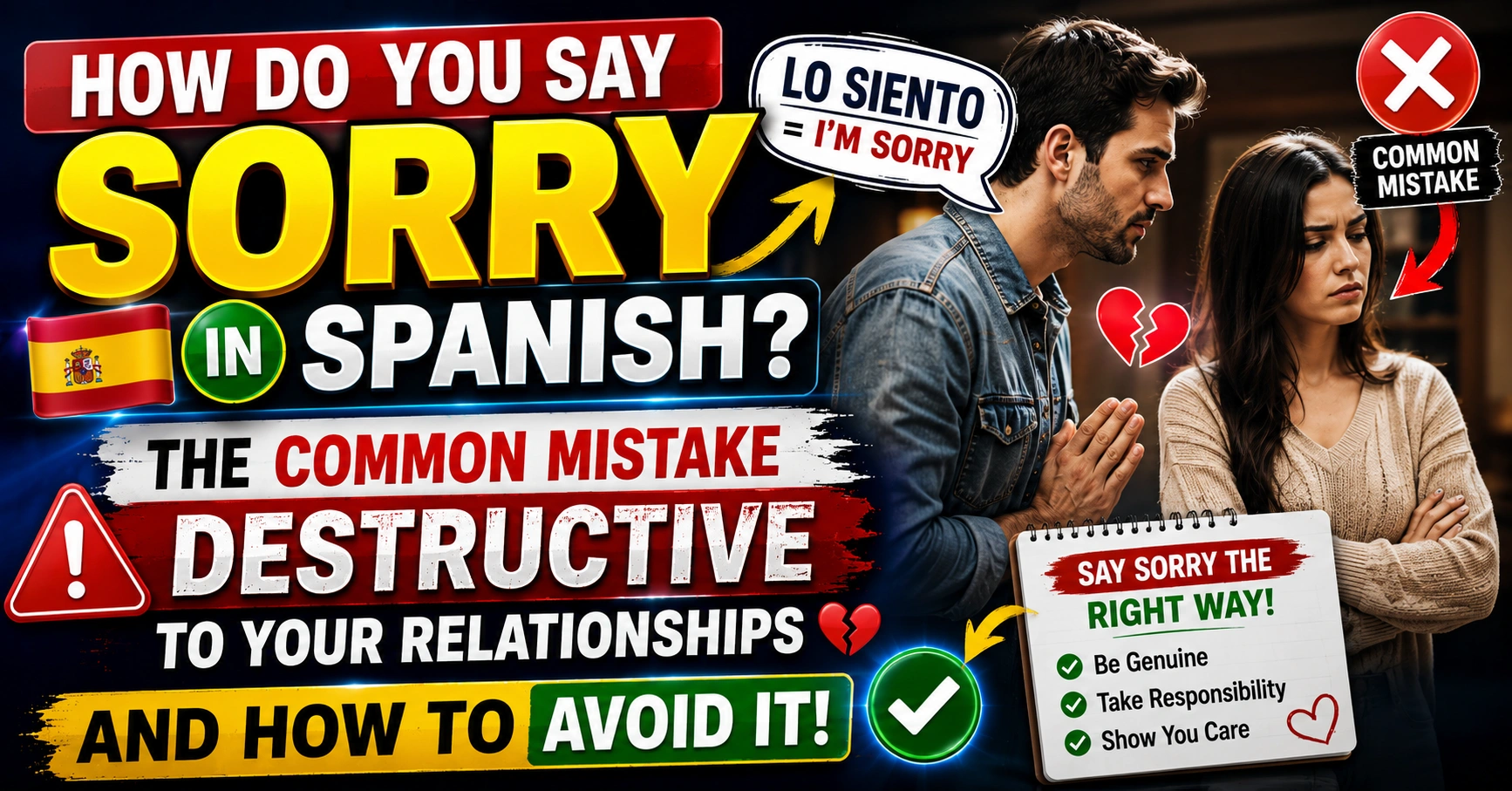
How do you say sorry in spanish? Stop making the ultimate linguistic blunder. Master the hidden cultural rules and correct terms right now.
Unlocking the true rhythm of global communication starts with a single word, but asking how do you say sorry in spanish reveals a shocking cultural minefield that most language apps completely hide from you. If you are relying on a simple translation tool, you are likely offending native speakers without even realizing it. This exclusive guide pulls back the curtain on the game-changing nuances of Hispanic etiquette to save you from ultimate social embarrassment.
The Definitive Spanish Apology Matrix
| Scenario / Context | Best Spanish Phrase | Intensity Level | Cultural Impact |
| Deep Regret / Serious Mistakes | Lo siento / Lo siento mucho | High | Personal & Emotional |
| Bumping into someone / Minor Interruption | Perdón / Perdóname | Medium | Social Etiquette |
| Passing through a crowd / Asking to leave | Con permiso | Low | Formal Politeness |
| Formal Business / Professional Regrets | Disculpe / Le pido disculpas | Medium-High | Respectful & Distant |
how do you say sorry in spanish
How do you say sorry in spanish: Overview & Fundamentals
When English speakers want to express regret, the universal word “sorry” covers everything from spilling a hot latte to breaking a lifelong promise. However, when you translate that mindset into Spanish, the system completely fractures. The foundational secret to understanding how do you say sorry in spanish lies in recognizing that the language categorizes accountability, empathy, and social space into entirely separate linguistic compartments.
If you use the wrong phrase in the wrong environment, you risk looking cold, overly dramatic, or culturally tone-deaf. For example, declaring your deep emotional sorrow for accidentally stepping on someone’s sneaker on a crowded subway sounds bizarre to a native speaker. Conversely, offering a casual shrug and a minor polite word when you have genuinely hurt a friend’s feelings can permanently damage your personal relationships. Understanding these core differences is the ultimate superpower for anyone looking to navigate the Spanish-speaking world with authenticity and respect.
Deep Dive: The Technical Breakdown of Real Spanish Apologies
To truly master the mechanics of communication, you must look past the literal dictionary entries. The choice you make depends entirely on the gravity of the situation and the relationship dynamic.
Here are the specific, high-stakes phrases you need to memorize immediately:
- Lo Siento (Literally: “I feel it”): This is the phrase most commonly taught to beginners, but it carries a heavy emotional weight. Use this for moments of genuine grief, deep empathy, or when you are taking responsibility for a serious mistake that caused real pain.
- Perdón (Meaning: “Pardon”): The ultimate Swiss Army knife of social interactions. It is the perfect, quick response for accidental physical contact, minor interruptions, or when you need to quickly correct a small mistake in conversation.
- Disculpe (Meaning: “Excuse me”): This is your defensive shield in formal or professional settings. If you need to grab a waiter’s attention, interrupt a business meeting, or ask a stranger for directions on the street, this is the most respectful tool at your disposal.
- Con Permiso (Meaning: “With permission”): This is a crucial cultural nuance. It does not mean you did something wrong; rather, it is a preventative apology used when physically passing in front of someone or leaving a dinner table.
Also Read: [Mastering Spanish Pronunciation: The 5 Secret Sounds Textbook Apps Never Teach You]
Expert Insights: The Deadly Pitfalls of Literal Translation
The biggest mistake digital nomads and global professionals make when learning how do you say sorry in spanish is relying on direct word-for-word translation. Language apps often treat “Lo siento” and “Perdón” as interchangeable synonyms, but using them incorrectly creates an immediate barrier between you and native speakers.
Pro-Tip: The Intention vs. Action Rule
Think of Perdón as an apology for an action you committed, while Lo siento is an expression of how you feel about a situation. If a friend tells you that their flight was cancelled, saying “Perdón” implies that you personally sabotaged the airplane. In that exact scenario, “Lo siento” is the mandatory choice because you are sharing their emotional frustration.
Furthermore, high-level business negotiations require an escalated level of formality. Dropping a casual “Perdón” in a corporate email can make you appear unprofessional. Instead, experts recommend using the reflexive structure: “Le pido disculpas por el inconveniente” (I ask you for apologies for the inconvenience), which instantly projects corporate maturity and linguistic fluency.
Trending Global Angle: The Digital Era of Intercultural Communication
In today’s hyper-connected world, digital communication across platforms like TikTok, WhatsApp, and Instagram has completely revolutionized how subcultures interact. With Latin music, streaming media, and remote work driving unprecedented global interest in Spanish-speaking cultures, conversational accuracy has never been more critical.
The rise of globalized workspaces means a simple email misunderstanding can derail a project. Millions of professionals are realizing that language is not just about vocabulary—it is about psychological alignment. Getting your apologies right shows a deep level of emotional intelligence that can fast-track international collaborations, social media engagement, and real-world networking success. how do you say sorry in spanish
Also Read: [Remote Work Etiquette: How to Avoid Cultural Missteps in International Slack Channels]
Conclusion
Mastering how do you say sorry in spanish requires you to look beyond simple vocabulary lists and embrace the cultural empathy woven into the language. By matching the correct level of regret to your specific social situation, you will instantly build trust and protect your international relationships from accidental friction. True fluency is not just about speaking without an accent—it is about apologizing with absolute precision.
Frequently Asked Questions (FAQ)
Is it better to say “Perdón” or “Lo siento” if I accidentally bump into someone?
It is far better to say “Perdón” or “Disculpe.” These phrases are designed for minor spatial infractions and social interruptions. Saying “Lo siento” implies a deep, emotional sadness that is far too intense for a simple bump on the street.
How do you say sorry in Spanish when someone passes away?
When offering condolences for a loss, the standard phrase is “Lo siento mucho” (I am very sorry) or, even more appropriately, “Mi más sentido pésame” (My deepest condolences). Never use “Perdón” or “Disculpa” in this situation, as those imply personal guilt.
What does “Con permiso” mean, and when should I use it?
“Con permiso” translates to “with permission.” It is a polite preventative apology used when you need to physically walk past someone in a tight space, squeeze through a crowd, or excuse yourself from a social gathering or dinner table.
Can I use “Disculpe” in a casual conversation with friends?
While “Disculpe” is perfectly understandable, it is the formal version of the phrase. When talking to close friends, family members, or peers of your own age, you should use the informal version, which is “Disculpa.”